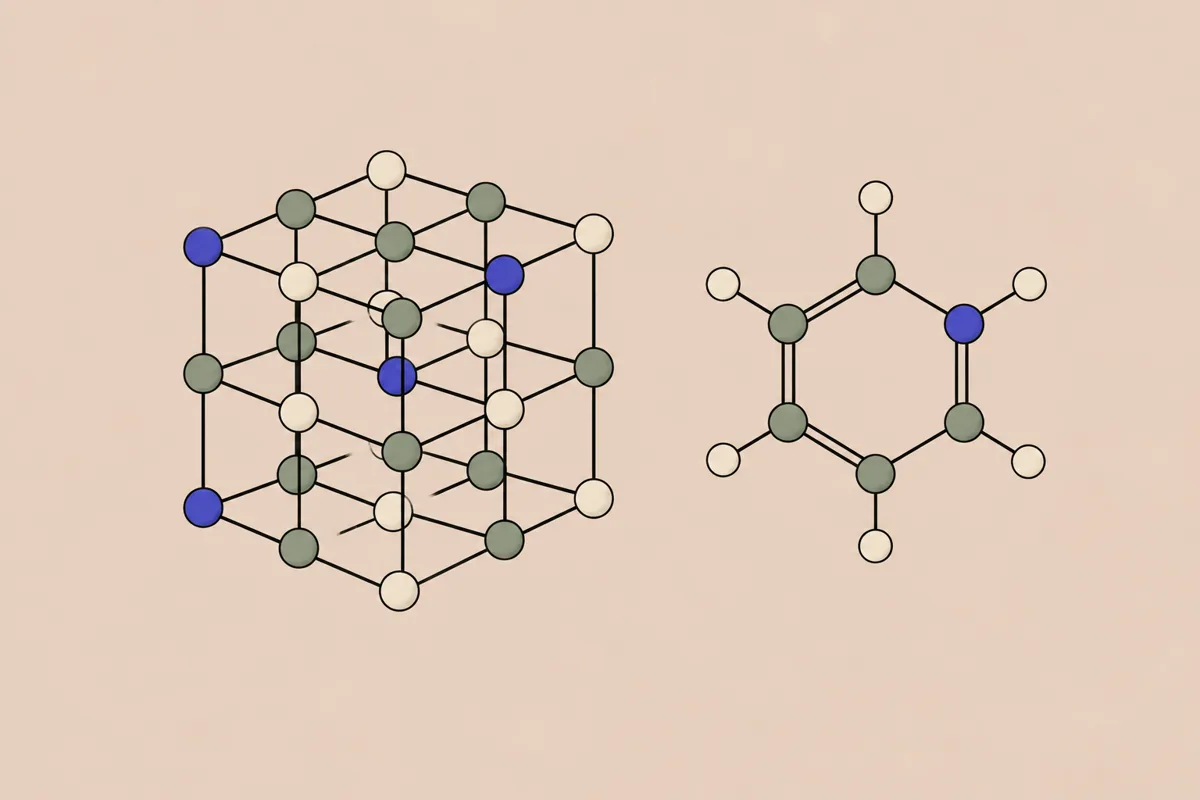
Crystallography Open Database
The Crystallography Open Database (COD) is an open-access collection of experimentally determined crystal structures, hosted at crystallography.net. Through ScholarMuse, an agent can find COD entries by exact formula, by an exact set of elements or by COD id, and get cell parameters, space group, the source publication and a link to the CIF file. COD answers slowly, so a lookup often takes a minute or more.
ScholarMuse tools: lookup_material. Each successful call uses credits.
Ask your agent
What your agent gets back
Every record carries id, source, title, url, license, attribution and retrievedAt. The fields below are the data that comes from Crystallography Open Database.
lookup_material
Records whose source is cod. These are experimental diffraction structures and carry no energies or band gaps.
- materialId
- COD id with a cod- prefix
- formula
- Formula as stored in COD (Hill notation)
- name
- Mineral, common or chemical name
- spacegroup
- Space group symbol
- spacegroupNumber
- Space group number
- crystalSystem
- Crystal system, derived from the space group number
- lattice
- a, b, c, alpha, beta, gamma and cell volume
- formulaUnitsPerCell
- Z, formula units per cell
- cellTemperatureK
- Cell measurement temperature in kelvin
- reference
- Authors, title, journal and year, up to 400 characters
- doi
- DOI of the source publication
- cifUrl
- Link to the CIF file
What it covers
- Experimentally determined crystal structures in COD, each with its source publication and a CIF link.
- Search by exact formula, by a list of 1 to 8 element symbols (structures made of exactly those elements), or by 7-digit COD id.
- Complements Materials Project and OQMD in the same tool: those give computed energies, COD gives measured structures.
Limits
- Slow. COD often takes 10 to 40 seconds to answer. Each attempt may wait 55 seconds and there are up to 2 attempts, so a lookup can take a minute or more.
- stable_only skips COD, because COD has no energies to judge stability from.
- Formula matching is exact, so TiO2 does not find Ti2O4 or doped variants. There is no search by mineral name, author or space group.
- At most 30 entries per call (default 10), shared with Materials Project and OQMD. The CIF itself is linked, not returned.
How ScholarMuse reaches Crystallography Open Database
The connector calls the COD search endpoint at crystallography.net/cod/result with format=json. A formula is rewritten in Hill notation first, because that is how COD stores it. No API key is sent.
Responses are cached for up to 7 days, so a repeated lookup is fast and newly added structures can take that long to appear.
API key: the upstream API can be called without one, so you do not add one.
Licence and attribution
Licence: CC0-1.0
Data from the Crystallography Open Database (crystallography.net), public domain (CC0). Cite the original publication given with each entry.
Records that come from Crystallography Open Database carry this licence and attribution. When you cite the data in a paper, follow Crystallography Open Database's own citation guidance.