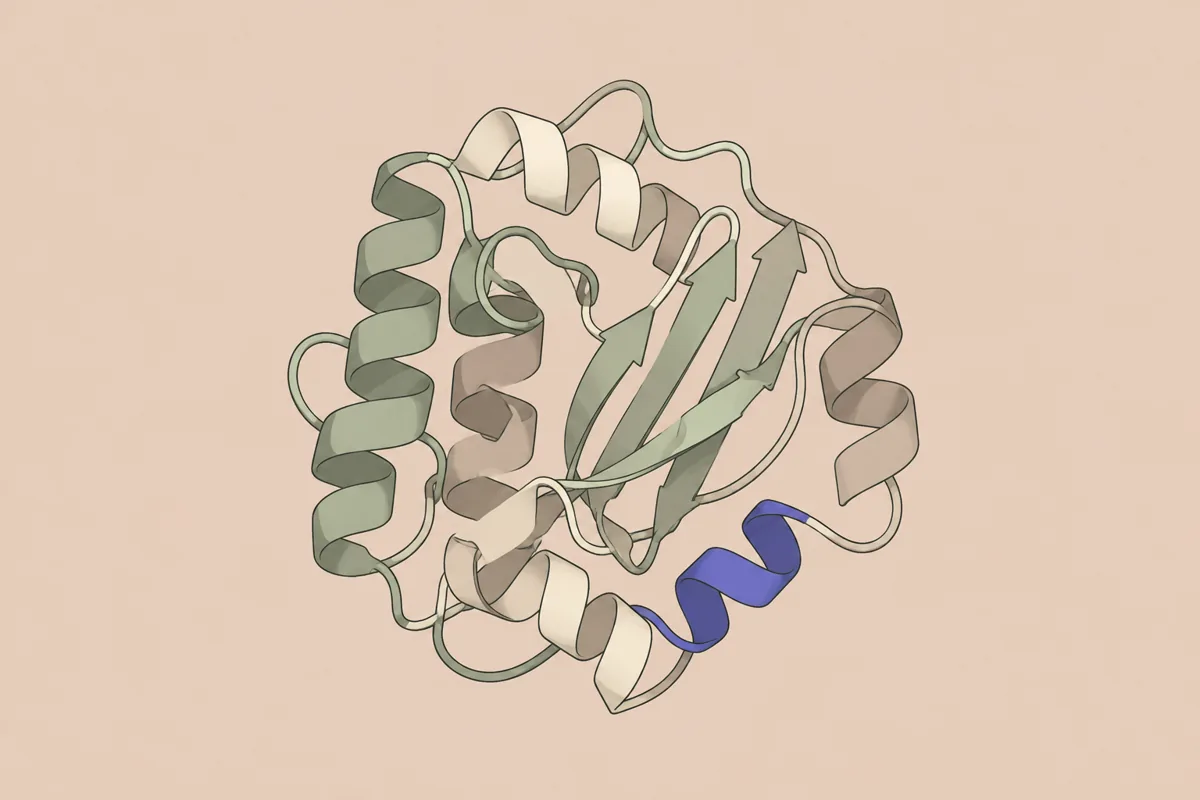
RCSB Protein Data Bank (PDB)
The RCSB Protein Data Bank (PDB) is the US archive of experimentally determined 3D structures of proteins and nucleic acids, run by the RCSB at rcsb.org. Through ScholarMuse, an agent can fetch one entry by PDB id, list the entries that contain a given UniProt protein with the best resolution first, or run a full-text search by protein name.
ScholarMuse tools: get_structure. Each successful call uses credits.
Ask your agent
What your agent gets back
Every record carries id, source, title, url, license, attribution and retrievedAt. The fields below are the data that comes from RCSB PDB.
get_structure
Records with kind "experimental" come from RCSB PDB. The same call may add one AlphaFold DB record.
- pdbId
- Four-character PDB id
- method
- Experimental method, e.g. X-ray diffraction
- resolutionAngstrom
- Resolution in ångström
- releaseDate
- Initial release date
- depositDate
- Deposition date
- organisms
- Source organisms, up to 5
- molecules
- Polymer entity descriptions, up to 6
- uniprotIds
- UniProt accessions in the entry, up to 8
- residues
- Deposited polymer residue count
- doi
- DOI of the primary citation
- pubmedId
- PubMed id of the primary citation
- mmcifUrl
- mmCIF file download link
What it covers
- Experimentally determined structures in the PDB archive, returned as entries (one record per PDB id).
- Three ways in: a PDB id, a UniProt accession (entries sorted by best resolution), or a name.
- A name is first matched to a human UniProt entry by exact gene symbol or protein name. If that fails, it goes to PDB full-text search.
Limits
- At most 25 experimental structures per call (default 10), first page only.
- Returns metadata and download links, not atomic coordinates. Very large structures are distributed as mmCIF only, so the pdbUrl link may not resolve for them.
- The id field accepts only a 4-character PDB id or a UniProt accession. Anything else must go in query.
- No filters for method, resolution cut-off, ligand or organism.
How ScholarMuse reaches RCSB PDB
The connector posts a query to the RCSB Search API (search.rcsb.org) to find entry ids, then reads entry details from the RCSB Data API GraphQL endpoint (data.rcsb.org). No API key is sent.
Search results are cached for up to 1 day and entry details for up to 7 days, so a newly released structure can take a day to show up.
API key: the upstream API can be called without one, so you do not add one.
Licence and attribution
Licence: CC0-1.0
Structure data from RCSB Protein Data Bank (rcsb.org), CC0.
Records that come from RCSB PDB carry this licence and attribution. When you cite the data in a paper, follow RCSB PDB's own citation guidance.